Why Gut Feel in Recruitment Costs More Than a Bad Hire
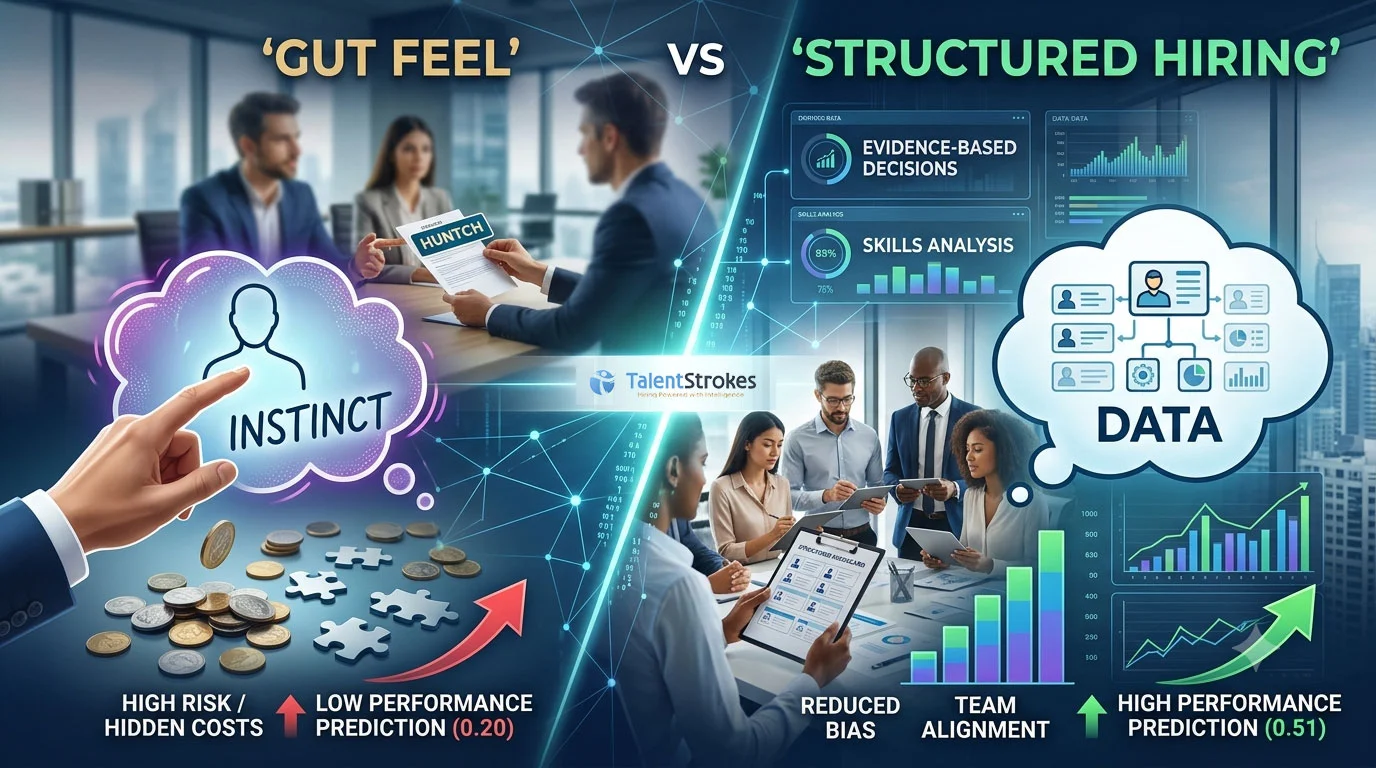
Let’s be real: trusting your gut in hiring feels quick and easy, but it comes with a price tag nobody wants to pay. When hiring managers lean on instinct, they skip the hard work, the deep dive that sorts out the folks who can actually do the job from those who just know how to charm a room. That shortcut opens the door for bias, and suddenly, you’re making decisions you can’t really back up. Plenty of those hires turn out to be mistakes you now own.
Because hiring is uncomfortable. There’s a lot of unknowns, and intuition seems like an easy way to cut through the noise. Picture a candidate who’s slick, confident, and says all the right things. It’s easy for a recruiter to think, “Yep, this is the one,” before they’ve even started checking if the candidate has the skills. That hit of certainty feels great in the moment. Since hiring’s always included some judgment calls, it’s easy to mix up a strong feeling with a smart decision. In truth, it’s just a reaction to the performance, not an honest look at what the person can do.
And it’s not just comfort, it’s speed, too. Real evaluation takes effort. You’ve got to fill out scorecards, collect feedback, sort through everyone’s opinions. Gut feel? It’s instant. When you’re under pressure to make a hire, it’s tempting to reach for the quickest answer.
Here’s where things get risky. Research shows people tend to favor candidates who remind them of themselves, same background, same way of talking. None of that is linked to actual job success. There’s a stat that always jumps out: unstructured interviews (the ones run on instinct) score only about 0.20 for predicting job performance. That’s low. Switch to structured interviews, with the same questions and scoring for everyone, and you’re up at 0.51. That’s a big jump. And it matters, because so many hires that felt “right” at the time turn out all wrong.
Human judgment isn’t the problem, it’s unstructured judgment that trips us up. Add a solid structure, and suddenly those hiring decisions get a lot stronger.
Turning over a bad hire isn’t just about salary. You’re looking at one to three times what you paid them, just for replacements. But that’s just the money. There’s time wasted realizing things aren’t working, all the frustration on the team, and, worst of all, the great candidates you lost along the way because they didn’t fit a hunch.
Your gut is built on your personal background and experiences, whether you notice or not. It steers you toward people who feel familiar. It’s not usually intentional, it’s just how intuition works. Problem is, those unseen biases shape every snap judgment, and they can silently guide you off track.
Structured hiring doesn’t care about impressions. It’s all about evidence. You ask focused, role-specific questions, score answers the same way across candidates, and involve a mix of people in the review. Now, your decision isn’t just a feeling, it’s backed by proof you can point to.
And don’t just ask about skills, have people show what they can actually do. Skills tests take the guesswork out of it.
Tools matter, too. If you hide details like names or backgrounds during screening, the focus stays where it should: on what the candidate can actually deliver. That’s how you get real fairness.
At TalentStrokes, ditching gut feel is the whole point. Our AI virtual interview agent asks the right job-based questions and checks problem-solving and key skills, matching every question to the candidate’s background. Each interview turns into useful data, not just nice vibes.
We also use clear scorecards and evaluation frameworks, so everyone judges by the same yardstick. All feedback shows up in one place, making it easy to see where people agree or disagree.
We even hide irrelevant candidate info during screening, so hiring managers pay attention to skills, not backgrounds. Our pipeline and tracker update in real-time, so nobody feels like they have to rush.
Gut feel isn’t a smart shortcut, it’s an error engine. It doesn’t just land you with lousy hires. You’ll miss out on top talent, and people start losing faith in how fair your process really is.
Putting structure in place doesn’t mean you lose human judgment. It actually gives you something better: clear information, reliability, and a real way to tell who’s the best fit. It’s not some drawn-out process, it’s just more accurate. And that accuracy is what keeps the hidden costs of gut feel out of your business.
Want to see how TalentStrokes brings in structure and consistency? Book a demo and check it out yourself.
Gut feel usually responds to how someone shows up, their confidence, friendliness, or similarity to the interviewer, not whether they’re actually good at the job.
Replacing a bad hire costs one to three times their annual pay. And it’s not just about money, you lose time, team morale drops, and work slows down while you fix the mistake.
Gut feel pulls from your background and memories, pushing you toward people who remind you of folks you already know. Most of the time, you don’t even notice it, but it still shapes nearly every decision.
Structured interviews use the same questions and a scoring system, with input from several people. Unstructured ones get made up on the spot, based on personal judgment. There’s a reason companies using structure end up with hires that actually perform better, it’s more than twice as accurate.
With TalentStrokes, every candidate faces the same job-focused questions, scored by AI. We collect feedback from all interviewers, and we hide any personal info that doesn’t matter. So every decision comes from facts, not snap impressions or gut feel. Companies finally get to build teams based on real evidence.